
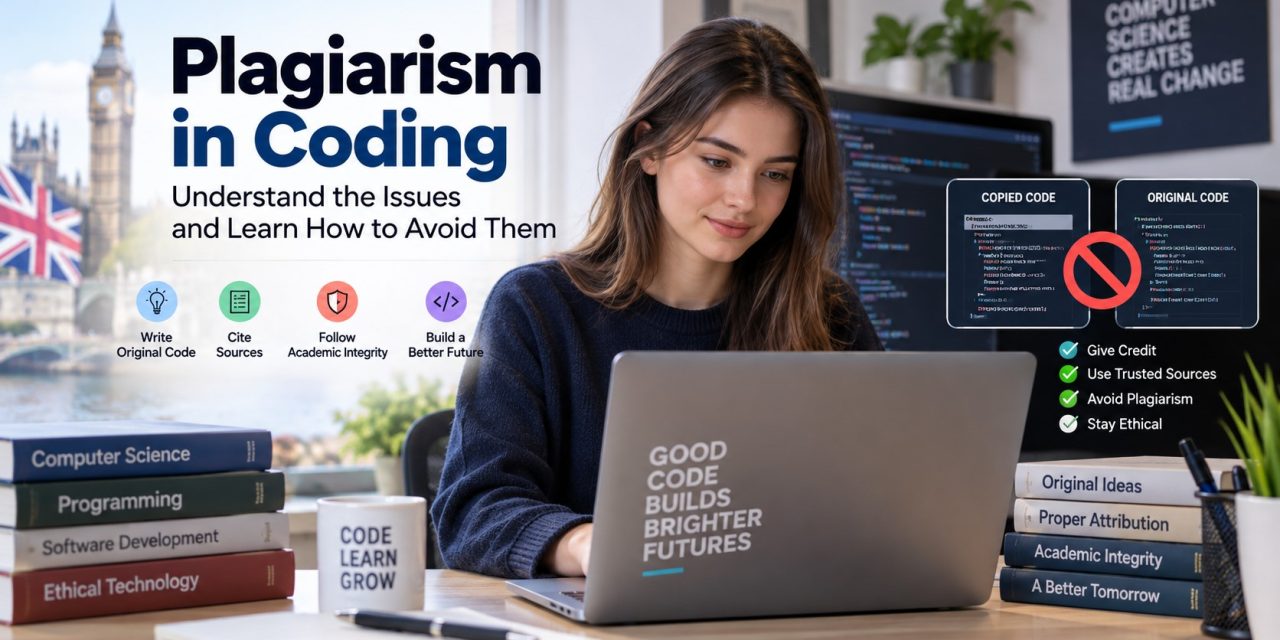
Code is a language that students and developers learn just like any other language. To learn how to code, people usually refer to code books, online resources, websites, GitHub, Stack Overflow, and online guides. Learning by using these resources is normal because coding is a techniques-based language and so people will look to other developers for answers. The problem is when people decide to copy and paste someone else’s code and present it as their own work. Plagiarism in the coding world means taking someone else’s code and passing it off as your own. Code theft will happen in school work and will happen on software projects in the professional world. Learning how to code by using code examples will protect your work from being copied and stolen, and will help build your programming skills.
What Is Code Plagiarism?
Code plagiarism is basically taking someone else’s code and presenting it as your own work. This could be an entire program or algorithm, a function, or even a small snippet of code.
There are plenty of techniques in programming to cover your tracks and still be considered plagiarism. Using someone else’s code and changing variable names is still plagiarism.
What Counts as Code Plagiarism?
There are plenty of online examples of people plagiarizing code. Students plagiarize code by copying their friend’s programming assignments. There are plenty of online examples of people copying code from a public repository and failing to credit the original authors.
Some other examples are:
- Copying code from GitHub without crediting the original source.
- Using Stack Overflow’s answers without referencing the original source.
- Turning in someone else’s code.
- Inventing code and passing it off as original.
- Using AI to generate code that is against the rules of your university.
Not all similar code resembles copied code. Several programmers can use the same basic algorithm, and the results may be similar. Some common programming tasks utilize the same syntax.
Why Does Coding Plagiarism Happen?
Programming plagiarism has various causes. It may be due to the demands of short deadlines, weak programming skills, lack of understanding of the citation rules, nor awareness of the implications of plagiarism. Students may consider that a ready-made solution available online does not need consideration of academic integrity.
It may also be accidental. A programmer may save a code snippet for later use that may lack attribution. A student may think simply modifying a small portion of a code creates a new and original code.
Intentional and Accidental Copying
Intentional code plagiarism occurs when a programmer takes existing code and presents it as original work.
Whereas accidental code plagiarism refers to a programmer having poor attribution or the lack of awareness of attribution.
Both can have adverse outcomes. However, recording your external sources appropriately should help mitigate most issues.
Consequences of Code Plagiarism
The effects of programming plagiarism are serious for students. Programming assignment plagiarism is likely to be considered a case of academic misconduct. Students may lose marks, fail the assignment, or experience other negative consequences.
The effects for professionals are likely different. Programmers face possible copyright infringement or intellectual property infringement issues. Software that contains copied code may present a problem for a business as its licensed software may be copied and broken.
Trust is eroded by plagiarism in coding as well. People expect you to be clear on the origins of your code.
How to Avoid Plagiarism in Coding
Relatively straightforward methods can be practiced to avoid plagiarism in programming assignments as long as habits are formed at the outset.
Write Your Own Code
Write original code instead of using copied answers.
A task may be broken down into smaller sub-tasks in order to understand what the program may need to do. This would require a planned algorithm and basic functions along with expected inputs and outputs. Each step can then be implemented and tested.
Example code may be used for learning. Code may not be directly copied to your answer. Understanding the idea and then providing your answer is the preferred way.
Version control can also assist you. Documentation of code changes and the history of a particular project can be archived using Git.
Cite Code Correctly
The methodology of proper citation comes into play by the use of another person’s work.
When a good code snippet is saved, the original location must be retained. Citation rules may require the name of the author, location of the code, web page, documentation page, or repository.
Author, source, permission, and license are the basic building blocks for attribution.
Due to licensing terms, not all code that are published and available in public repositories may be used without restrictions. Doling out attribution is often avoided by many.
How to Check Code for Plagiarism
Students ask how to detect if source code has been plagiarized.
Plagiarism checkers for source code can compare source code to other source code files. Some tools implement token matching, syntax similarity, structural similarity, code fingerprinting, or clone detection.
More advanced systems can compare abstract syntax trees (AST). This can determine program structures that utilize different variable names.
Similarity scores cannot determine if a source code file is stolen. Plagiarism in programming can be avoided by checking all code for plagiarism prior to submitting the source code. Review copied code, citations and external libraries, and other sources.
AI-Generated Code and Plagiarism
Source code plagiarism detection will become more important as AI coding tools become more widely used by students and developers. AI can write code from scratch, write functions, explain code, find typos in code, and even suggest code.
AI based coding produces some concerns about originality and authorship.
Is AI-Generated Code Plagiarism?
AI generated code is not plagiarism in and of itself. Context is required to make a plagiarism determination.
Some universities permit AI related assignments so long as students disclose their AI code usage to the professor. Other universities restrict the use of code generation tools for specific types of assignments.
Students should review their university’s AI code usage policy before submitting LLM generated code.
Source code also requires review by a human. Determine if the code functions correctly and if you understand it. Additionally, other factors such as code similarity and subsequent copyright issues, the origin of the code or plagiarism, and licensing come into play.
Use AI Tools Responsibly
Review code before submission. Make sure you understand each part.
Follow the disclosure policy for your university/teacher/employer/client. If you used AI code, describe how and to what extent your coding assistant was used.
Trustworthy use of AI code can promote and enforce learning.
How to Prevent Code Plagiarism
Programming plagiarism has simple preventative measures.
Write program code on your own and include findings from your research. Document your sources and credit code when needed. Review the license of a program/code before use. Never copy a classmate’s work.
Students must understand the Rules of Collaboration. Helping a classmate with a programming problem may be acceptable, but providing a programming solution may not be.
Plagiarism in programming is easily avoided by following basic Rules of Academic Honesty and sourcing each program or code segment used.
Keep Your Code Original and Properly Cited
Students can avoid plagiarism by writing code themselves and following academic integrity rules in their programming assignments. When using online sources, such as Stack Overflow, any copied code, including source code examples, should be properly cited. A code plagiarism checker can help detect plagiarism by checking code across different programming languages. Modern code plagiarism detection may compare similar code and provide a similarity score as a measure of software similarity. However, the score alone does not prove plagiarism, so students should review the results carefully. An AI tool can also support learning, but students should understand the rules before using generated content as original code. For more guidance, check the frequently asked questions below.
Final Thoughts
Programming plagiarism, failure to cite programs used, unauthorized code reuse, a breach of collaboration guidelines, and thoughtless AI code use could all be considered forms of plagiarism. Similar code is not a defense for plagiarism.
The recommendation is to understand the task completely and provide an independent solution. Mention the sources and provide the necessary credit. Familiarize yourself with your university’s AI policy and abide by the guidelines.
These solutions encourage programming practice to produce original work.
Frequently Asked Questions (FAQs)
Q1. What do you mean by code plagiarism?
Code plagiarism includes presenting copied programming code as your own, whether that be an entire program, function, algorithm, or even a small piece of code. Deception of this form is taken very seriously.
Q2. Is copying code from GitHub considered plagiarism?
It is indeed plagiarism, as code copied from GitHub may still be subject to copyright and/or licensing. Most importantly, students should abide by the academic integrity policy at their respective universities before even thinking about coding from GitHub.
Q3. How do I ensure I don't plagiarize in a programming assignment?
The first and most important part of this is to write your own code. Make sure to cite the source of any code you didn’t write. Do not simply adjust someone else’s code.
Q4. Can copying someone else's code be detected?
Absolutely. Checkers designed to to detect individual segments of code that were copied from elsewhere. Similar segments of code do not necessarily mean someone copied it.
Q5. Is it safe to use AI tools to write code for assignments?
Risk management policies vary by institution. Assignment coding using AI tools and the policy on AI in coding are flexible. Always be aware of the institution’s policy and state the use of AI when instructed.


