
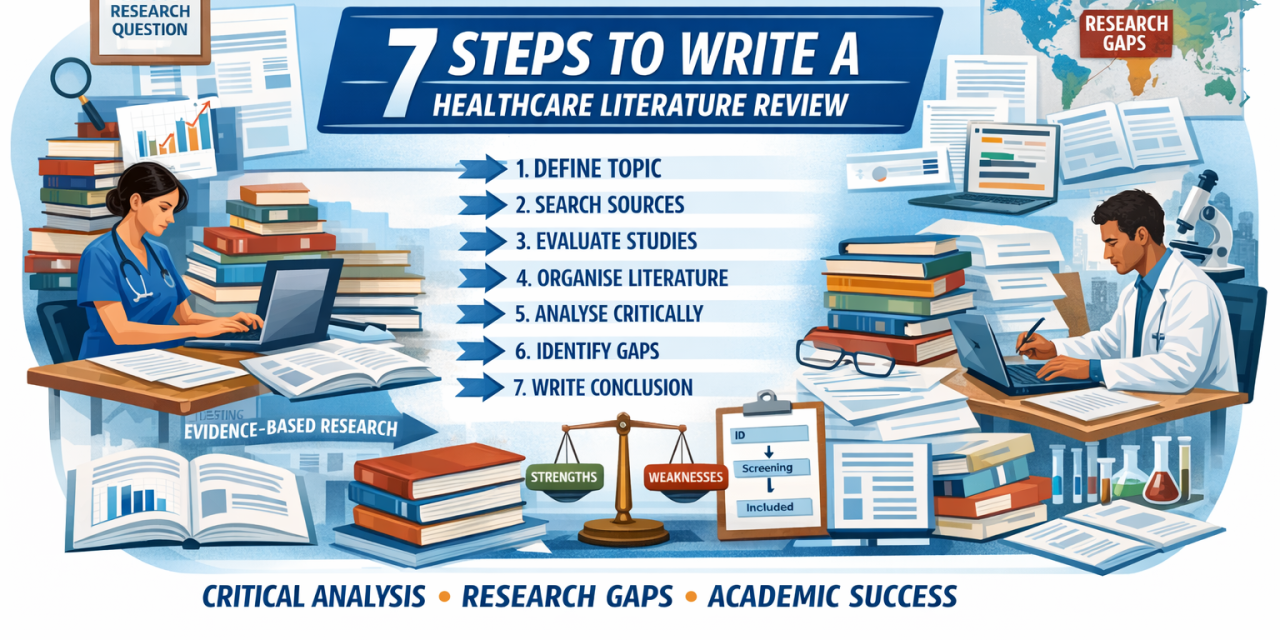
Most healthcare assignments, research papers, theses, and dissertations need a good literature review. Before they present their own study, students in nursing, medicine, public health, pharmacy, and healthcare management have to look at what other people have already found. Any study in healthcare needs a literature review to show how the research you are doing fits in with existing data and current debates.
There are a lot of students looking for a clear healthcare literature review guide because they find it hard to organise their sources, judge the quality of the study, and make their arguments make sense. There is more to a literature review than just a list of articles. It is a planned academic conversation that looks at study trends, compares methods, rates strengths and weaknesses, and finds knowledge gaps. Students can improve their critical thinking, academic writing, and research evaluation skills by learning how to write a healthcare literature review.
Following step by step guide for a healthcare literature review will help you stay clear, make sense, and do an organised analysis that meets global academic standards.
Why a Literature Review Matters in Healthcare?
A literature review explains what researchers already know about a specific healthcare topic. It evaluates peer-reviewed journal articles, systematic reviews, meta-analyses, clinical guidelines, and policy reports. In healthcare education, evidence-based practice depends on reliable and critically evaluated research.
A well-written literature review:
- Defines key healthcare concepts and theories
- Analyses research designs and data collection methods
- Identifies strengths and methodological limitations
- Highlights research gaps and inconsistencies
- Supports the justification for your study
Universities worldwide expect analytical discussion rather than descriptive summaries. This is why many students look for healthcare assignment literature review tips before starting their work.
Step 1: Define a Clear Research Question
Focus on a Specific Topic
The first step in nursing literature review writing steps is defining a focused research question. A broad topic such as “mental health” is too general. Instead, narrow it to a measurable and researchable issue, such as “the impact of cognitive behavioural therapy on adolescent anxiety in primary care settings.”
A clear literature search question guides your entire review. It helps determine which studies are relevant and which should be excluded.
You can use structured frameworks such as:
- PICO (Population, Intervention, Comparison, Outcome)
- SPIDER (Sample, Phenomenon of Interest, Design, Evaluation, Research type)
For example, in a PICO framework:
- Population: Elderly patients
- Intervention: Telehealth monitoring
- Outcome: Reduced hospital readmission
A focused question ensures that you follow the correct healthcare research literature review format.
Step 2: Search for Relevant Sources
Use Academic Databases
A strong public health literature review guide always recommends using trusted academic databases. Avoid non-academic websites and opinion blogs.
Reliable databases include:
- PubMed
- CINAHL
- Scopus
- Web of Science
- Cochrane Library
- Google Scholar (with caution)
Use precise keywords related to your topic. Combine them using Boolean operators:
- AND (to narrow search)
- OR (to expand search)
- NOT (to exclude terms)
Example:
“nursing burnout” AND “patient safety”
Select peer-reviewed studies published within the last 5–10 years unless foundational research is necessary.
Step 3: Evaluate and Select Quality Studies
Assess Credibility and Relevance
Not every article you find should be included. Evaluating study quality is essential in literature review methodology in healthcare.
Assess:
- Author expertise
- Research design (qualitative, quantitative, mixed methods)
- Sample size and diversity
- Data collection methods
- Ethical approval
- Study limitations
- Statistical validity
Systematic reviews and randomised controlled trials generally provide stronger evidence than narrative opinions.
Create a spreadsheet to record:
- Author and year
- Study objective
- Methodology
- Key findings
- Strengths and weaknesses
Using reference managers such as EndNote, Zotero, or Mendeley can help organise citations.
Step 4: Organise the Literature
Group Studies by Themes
Avoid summarising articles one by one. Instead, group studies into meaningful categories.
Common grouping methods include:
- Thematic organisation
- Methodological comparison
- Chronological development
- Population-based grouping
- Geographic region
For example, in a diabetes management review, themes might include:
- Lifestyle interventions
- Medication adherence
- Digital health monitoring
- Patient education programs
This thematic structure improves clarity and aligns with proper medical literature review structure.
Step 5: Develop a Clear Academic Structure
A well-structured healthcare research literature review format typically includes:
1. Introduction
- Introduce the topic
- State the research problem
- Define scope and objectives
- Briefly mention search strategy
2. Main Body
- Present themes or methodological discussions
- Compare and contrast findings
- Discuss theoretical frameworks
Example analytical sentence:
“Several studies report improved patient outcomes with nurse-led interventions; however, limited sample diversity reduces generalisability.”
This demonstrates evaluation rather than simple reporting.
3. Critical Analysis
Discuss:
- Evidence strength
- Bias
- Methodological weaknesses
- Inconsistencies
Students seeking healthcare dissertation literature review help often struggle here because synthesising multiple studies requires analytical skill.
4. Research Gaps
Identify areas needing further investigation and find gaps in the literature review.
5. Conclusion
Summarise key insights and connect to your research aim.
Step 6: Apply Critical Analysis
Critical analysis is the core of your literature review. It moves your writing from descriptive to analytical.
Evaluate:
- Strength of evidence
- Research consistency
- Methodological reliability
- Confounding variables
- Sampling bias
Use linking phrases such as:
- However
- In contrast
- Similarly
- Conversely
- Furthermore
Example:
“Although qualitative studies highlight improved patient satisfaction, quantitative research demonstrates inconsistent outcome measurements.”
Avoid personal opinions. Base all arguments on published evidence.
Many students seek Healthcare assignment help at this stage because critical reasoning requires structured academic writing.
Step 7: Identify Gaps and Conclude
A strong review ends with insight, not repetition.
Ask yourself:
- Which populations are under-researched?
- Are findings conflicting?
- Are methodologies outdated?
- Is there limited geographic diversity?
Example:
“Limited research evaluates telehealth interventions in low-income countries, indicating the need for cross-cultural clinical studies.”
Conclude by reinforcing how your research addresses these gaps.
________________________________________
Advanced Strategies for Higher-Level Reviews
Undergraduate reviews focus on summarising and analysing existing research. Postgraduate and doctoral reviews require deeper synthesis and theoretical alignment.
Students who follow a structured healthcare literature review guide produce organised and research-driven work that meets global standards.
Advanced Strategy 1: Develop a Search Strategy Plan
Create a structured search matrix that includes:
- Keywords and synonyms
- Boolean combinations
- Databases searched
- Inclusion/exclusion criteria
- Date filters
This increases transparency and academic credibility.
Advanced Strategy 2: Use PRISMA Logic
PRISMA flow diagrams show:
- Articles identified
- Articles screened
- Articles excluded
- Final articles included
Even if not required, explaining your screening process strengthens methodological clarity.
Advanced Strategy 3: Integrate Theoretical Frameworks
Healthcare research often relies on:
- Health Belief Model
- Social Determinants of Health
- Patient-Centred Care framework
- Evidence-Based Practice model
Connect findings to theory to demonstrate depth.
Example:
“Telehealth adoption aligns with the Technology Acceptance Model, which emphasises perceived usefulness.”
Advanced Strategy 4: Compare Study Designs
Analyse differences between:
- Qualitative vs quantitative methods
- Cross-sectional vs longitudinal research
- Randomised trials vs observational studies
Example:
“While interviews provide patient insight, survey-based research offers measurable outcome comparisons.”
Address Ethical and Cultural Context
Healthcare systems vary worldwide. Consider:
- Policy differences
- Funding models
- Access inequalities
- Technological resources
Global awareness strengthens analytical depth.
Common Mistakes to Avoid
- Descriptive summaries without analysis
- Overuse of outdated sources
- Poor referencing
- Lack of theme organisation
- Weak research gap discussion
Following a clear healthcare literature review guide prevents these issues.
Referencing and Academic Integrity
Always follow required styles such as APA, Harvard, or Vancouver. Cite every source properly. Paraphrase carefully. Use plagiarism detection tools before submission.
Academic integrity is essential in healthcare research.
Useful Tools for Writing
Students can improve efficiency using:
- Zotero or EndNote
- Academic databases
- Plagiarism checkers
- Grammar tools
- Research mapping software
These tools ensure professional structure.
When to Seek Academic Support
Writing a literature review can be challenging, especially at postgraduate level. If you struggle with synthesis or structure, academic guidance can support your learning.
Many students seek Public Health Assignment Help for complex research involving epidemiology, policy analysis, and statistical evaluation.
Seeking support improves understanding and academic quality.
Frequently Asked Questions (FAQs)
What is a healthcare literature review?
A healthcare literature review is a structured academic analysis of research that has already been done on a certain subject in healthcare. It looks at policy reports, clinical studies, peer-reviewed journal papers, and systematic reviews to find out what we know now about nursing, medicine, or public health. It doesn’t just summarise each study; instead, it compares results, rates research methods, and looks for gaps or contradictions in the evidence that is already out there. A study of the healthcare literature backs up a clear research question and provides a solid base for further research. It shows that you know about the topic, can think critically, and understand how to use evidence-based practice in academic writing and healthcare research.
What is the structure of a healthcare literature review?
A healthcare literature review generally has an introduction, a main body, a discussion of the research gap, and an end. In the introduction, the topic, study goal, and scope of the review are laid out. The main body sorts studies by subjects or research methods, then compares the results and figures out what works and what doesn’t. A study gap section points out areas that haven’t been studied enough or where the evidence isn’t clear. In the conclusion, the main points are summed up and connected to the study question. To keep academic standards in healthcare research, you need to use correct citations, organise your information logically, and style your work consistently.
How do you critically analyse healthcare studies?
To critically analyse healthcare studies, you need to do more than just talk about the results. You also need to judge the quality of the study. As part of this, the study design, group size, data collection methods, statistical analysis, and ethical approval must all be looked at. Look at the results of various studies and see what is the same, what is different, and what doesn’t make sense. Think about any biases that might be present, the limits of the methods used, and whether the results can be applied to larger groups of people. A strong critical analysis also checks to see if the conclusions are backed up by facts. Using linking words like “however” or “in contrast” shows that you can evaluate things fairly and think critically.
Why is evidence-based practice important in literature reviews?
Evidence-based practice makes sure that choices about health care and academic arguments are based on solid research. It helps you find good studies like systematic reviews, clinical trials, and peer-reviewed research for a literature review. This method boosts credibility and makes study more accurate. Evidence-based practice also connects what we know about healthcare in theory with what happens in real life. This helps us care for patients better and make smarter policy choices. Using strong evidence boosts academic honesty and makes sure that conclusions are based on proven scientific study instead of guesswork.
What are the 7 steps to write a healthcare literature review?
The seven steps are: coming up with a clear research question; searching academic sources; judging the quality of the studies; organising research into themes; creating a structured format; using critical analysis; and finding research gaps with a strong conclusion. These steps make sure that the literature review is well-thought-out, based on data, and in line with the standards expected in nursing, medicine, and public health research.
How do you start a healthcare literature review?
Start by defining a focused and researchable question using frameworks such as PICO or SPIDER. Then create a search strategy using reliable databases like PubMed or CINAHL. A clear introduction should explain the topic, research aim, and scope. Beginning with a structured plan prevents confusion and improves academic clarity.
What databases should be used for a healthcare literature review?
Reliable databases include PubMed, CINAHL, Scopus, Web of Science, and the Cochrane Library. These platforms provide peer-reviewed research, systematic reviews, and clinical studies. Using trusted academic databases ensures evidence-based content and improves the credibility of your healthcare literature review.
How many sources are required for a healthcare literature review?
The number of sources depends on academic level. Undergraduate reviews typically require 15–30 peer-reviewed sources. Postgraduate or dissertation-level reviews may require 40–60 or more studies. Always follow your university guidelines while ensuring that selected sources are recent, relevant, and evidence-based.
What is the difference between a systematic and narrative healthcare literature review?
A systematic review follows a structured methodology with defined inclusion and exclusion criteria, often using PRISMA guidelines. A narrative review provides thematic discussion without strict screening procedures. Systematic reviews are more detailed and methodologically transparent, while narrative reviews focus on broader analysis.
How do you critically analyse studies in a healthcare literature review?
Critical analysis involves evaluating research design, sample size, methodology, data collection methods, statistical validity, and ethical considerations. Instead of summarising results, compare findings, identify limitations, and assess the strength of evidence. This approach strengthens academic quality and demonstrates analytical thinking.
Why is evidence-based practice important in healthcare literature reviews?
Evidence-based practice ensures that arguments are supported by credible and peer-reviewed research. It strengthens academic reliability and improves research relevance. Using validated clinical studies and systematic reviews enhances the overall quality and trustworthiness of the literature review.


